- Credits: 3
- Coefficient: 1
- Volume Horaire: 45h (Cours: 15h, TD: 15h, TP: 15h)
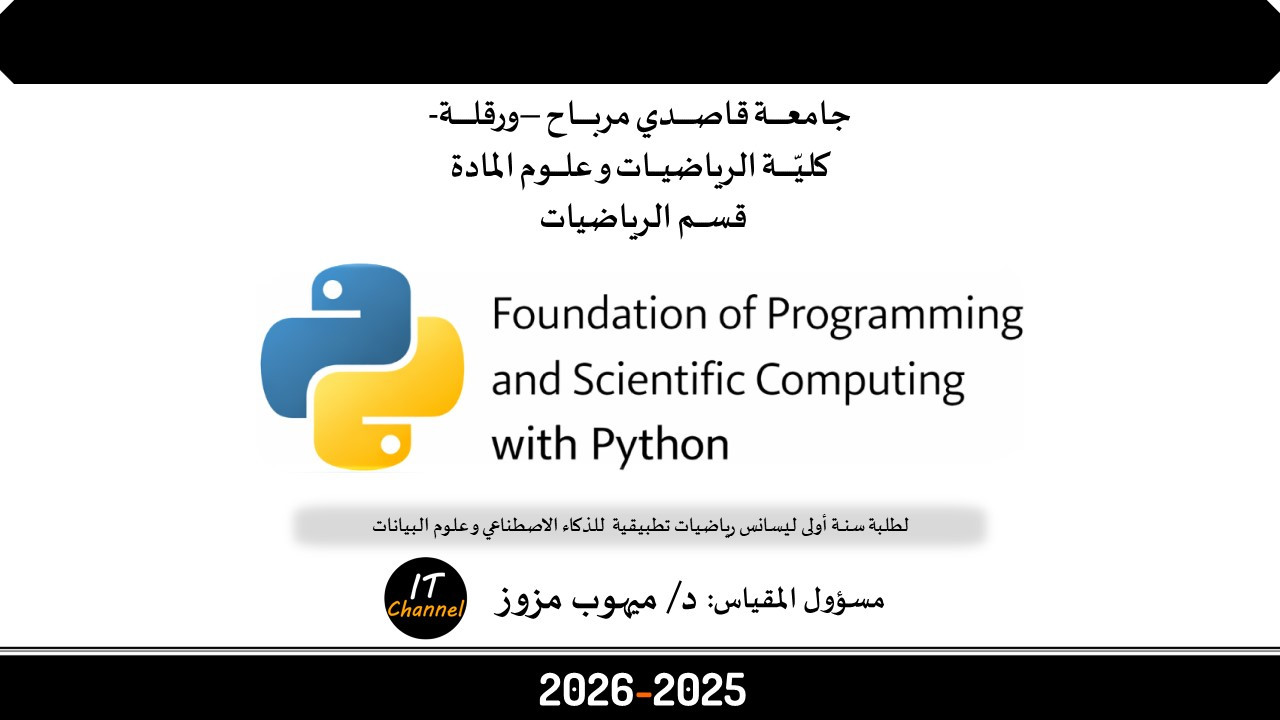
- Objectives: Teach foundational programming skills in Python and their application to scientific computing in mathematics and data science.
- Prerequisite Knowledge: Basic computer literacy, Algorithmique et Structure de Données 1.
- Content:
- Chapter 1: Python Basics
- Variables, data types, control structures
- Functions, modules, libraries
- Chapter 2: Scientific Computing Libraries
- NumPy: arrays, linear algebra
- SciPy: numerical methods
- Matplotlib: plotting and visualization
- Chapter 3: Numerical Methods
- Solving linear systems
- Root finding, numerical integration
- Chapter 4: Applications
- Simulating mathematical models
- Data analysis and visualization
- Note: Practical work focuses on implementing numerical algorithms in Python.
- Evaluation: Exam (50%), Continuous Assessment (50%)
- References:
- J. VanderPlas, Python Data Science Handbook, O’Reilly, 2016
- A. B. Downey, Think Python, O’Reilly, 2015
- H. P. Langtangen, A Primer on Scientific Programming with Python, Springer, 2016
- Teacher: Mihoub MAZOUZ