
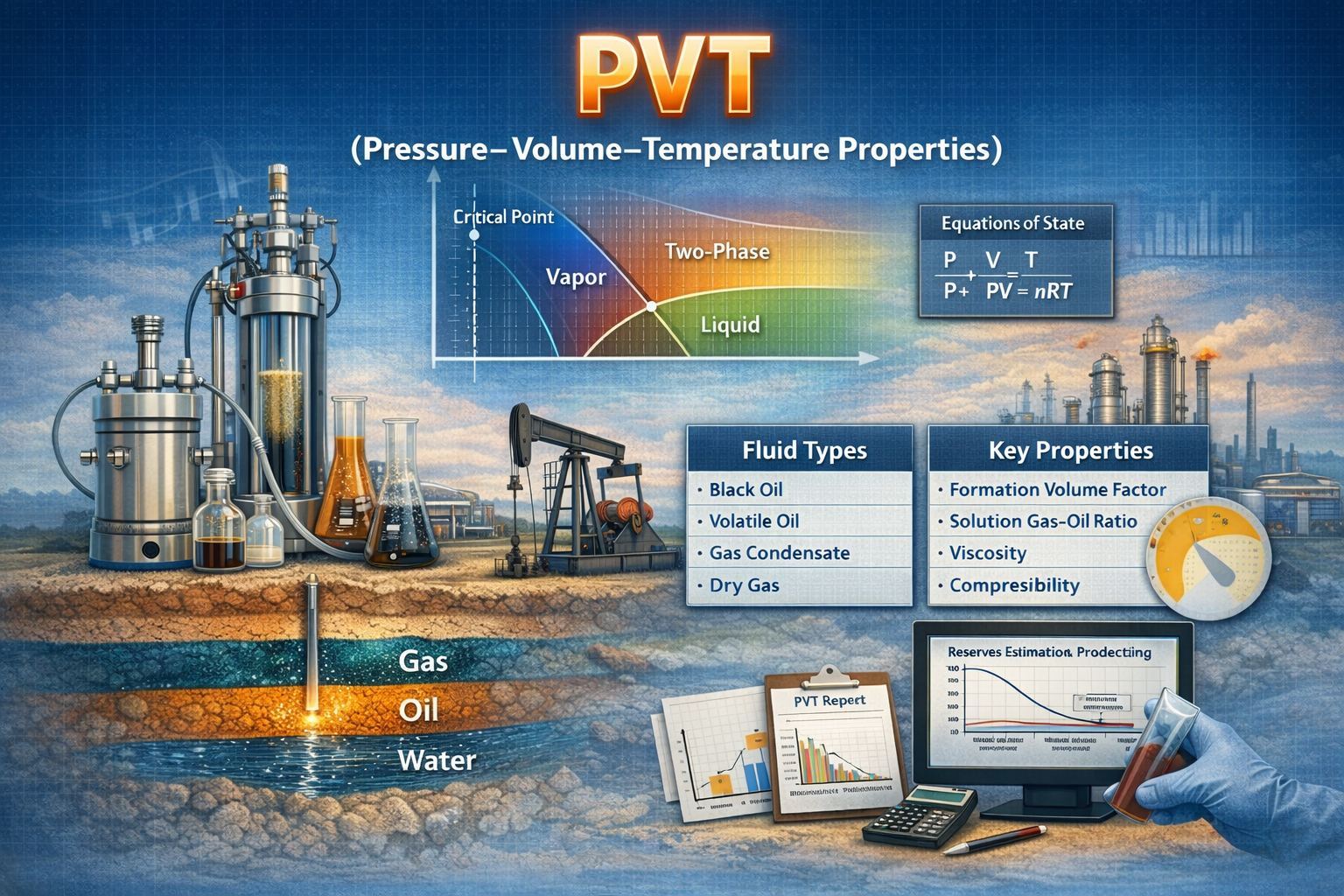
The PVT module introduces the fundamental pressure–volume–temperature (PVT) properties of reservoir fluids and their importance in petroleum engineering applications. The course focuses on understanding the physical behavior of oil, gas, and formation water under reservoir and surface conditions and how PVT properties influence reservoir performance, well productivity, and surface processing.
Students will learn the basic concepts of phase behavior, fluid classification, and the relationships between pressure, temperature, and fluid volume. The module covers key PVT parameters such as formation volume factors, solution gas–oil ratio, compressibility, viscosity, and density. Standard laboratory PVT tests and common empirical correlations used in engineering calculations are also introduced.
Emphasis is placed on practical interpretation of PVT data and its use in reservoir engineering calculations, including material balance, reserves estimation, and production forecasting. Simple field examples are used to help students connect theoretical concepts with real petroleum engineering practice.
Learning Outcomes:
By the end of this module, students will be able to:
-
Understand the basic PVT behavior of oil, gas, and water.
-
Identify different types of reservoir fluids and their characteristics.
-
Calculate and interpret key PVT properties.
-
Use PVT data and correlations in basic reservoir engineering applications.
-
Recognize the role of PVT properties in production and surface facility design.
Prerequisites:
Basic thermodynamics and introductory petroleum engineering.
- Teacher: Zakaria Adjou