
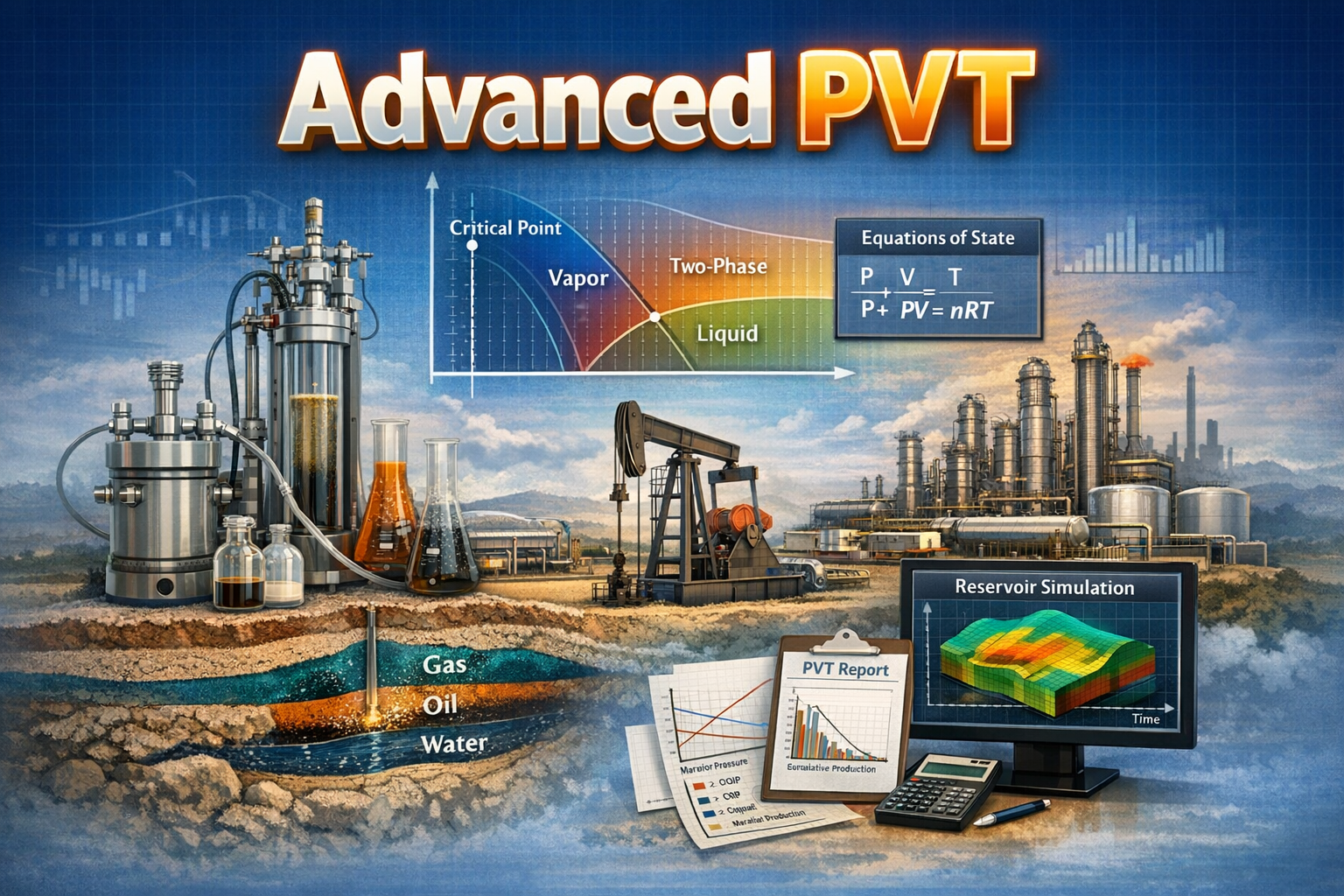
The Advanced PVT module provides an in-depth understanding of the pressure–volume–temperature (PVT) behavior of reservoir fluids and its impact on reservoir engineering and production performance. Building on fundamental PVT concepts, this module focuses on advanced fluid characterization, laboratory PVT analysis, and the application of PVT properties in reservoir studies, well performance, and surface facility design.
Students will study the thermodynamic behavior of black oils, volatile oils, gas condensates, and dry gas systems under reservoir and surface conditions. Emphasis is placed on interpreting laboratory PVT reports, selecting appropriate correlations and equations of state (EOS), and understanding phase behavior through phase diagrams. The module also highlights the role of PVT data in material balance, reservoir simulation, and production forecasting.
Practical case studies and field-oriented examples are used to link theory with real petroleum engineering applications, enabling students to critically analyze PVT uncertainties and their consequences on reservoir management decisions.
Learning Outcomes:
By the end of this module, students will be able to:
-
Analyze and interpret advanced PVT laboratory data (CCE, DL, CVD, separator tests).
-
Understand phase behavior and phase diagrams of reservoir fluids.
-
Apply PVT correlations and equations of state for different fluid systems.
-
Evaluate the impact of PVT properties on reserves estimation, recovery mechanisms, and production strategy.
-
Integrate PVT data into reservoir engineering and simulation workflows.
Prerequisites:
Basic PVT properties, thermodynamics, and introductory reservoir engineering.
- Teacher: Zakaria Adjou
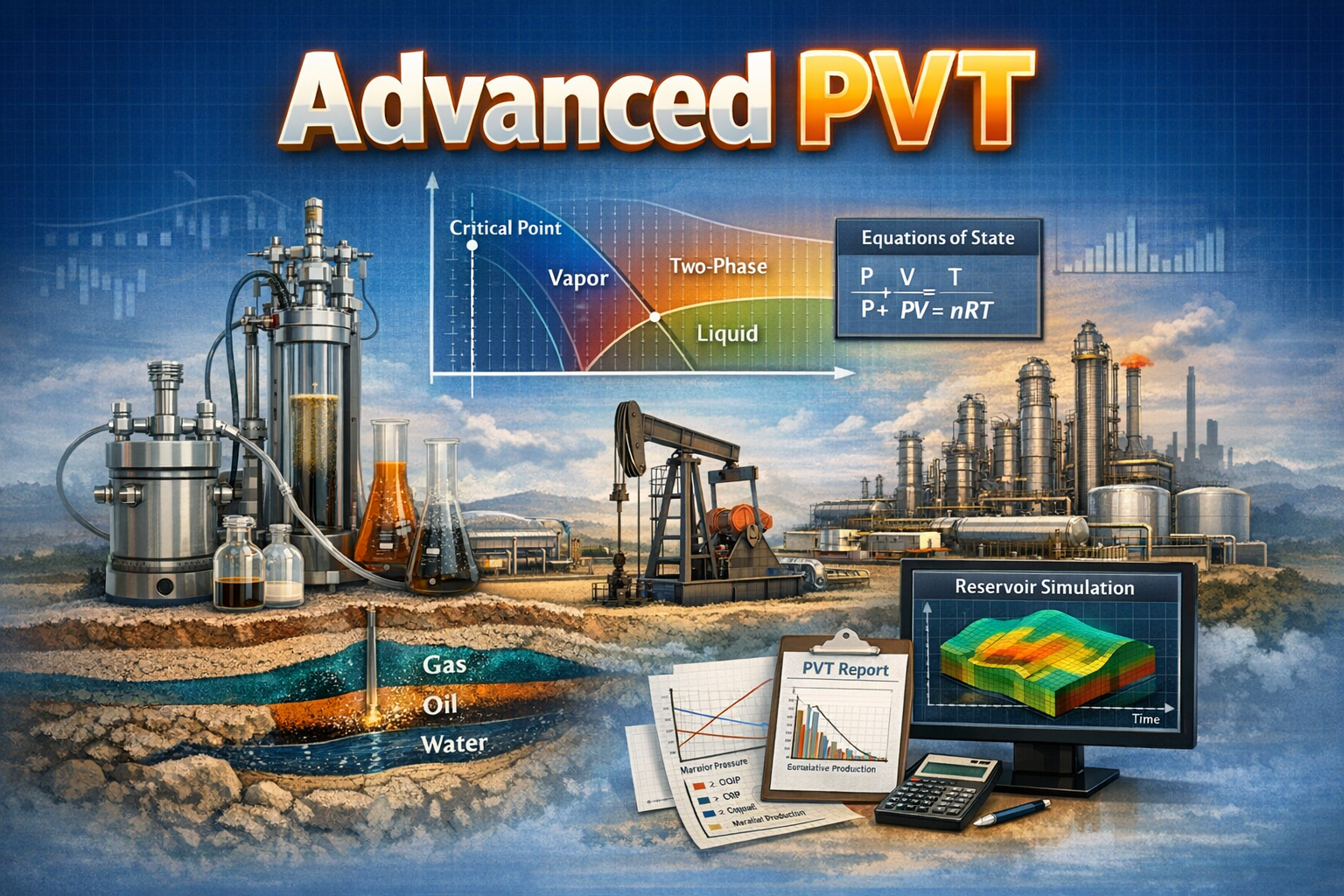
The Advanced PVT module provides an in-depth understanding of the pressure–volume–temperature (PVT) behavior of reservoir fluids and its impact on reservoir engineering and production performance. Building on fundamental PVT concepts, this module focuses on advanced fluid characterization, laboratory PVT analysis, and the application of PVT properties in reservoir studies, well performance, and surface facility design.
Students will study the thermodynamic behavior of black oils, volatile oils, gas condensates, and dry gas systems under reservoir and surface conditions. Emphasis is placed on interpreting laboratory PVT reports, selecting appropriate correlations and equations of state (EOS), and understanding phase behavior through phase diagrams. The module also highlights the role of PVT data in material balance, reservoir simulation, and production forecasting.
Practical case studies and field-oriented examples are used to link theory with real petroleum engineering applications, enabling students to critically analyze PVT uncertainties and their consequences on reservoir management decisions.
Learning Outcomes:
By the end of this module, students will be able to:
-
Analyze and interpret advanced PVT laboratory data (CCE, DL, CVD, separator tests).
-
Understand phase behavior and phase diagrams of reservoir fluids.
-
Apply PVT correlations and equations of state for different fluid systems.
-
Evaluate the impact of PVT properties on reserves estimation, recovery mechanisms, and production strategy.
-
Integrate PVT data into reservoir engineering and simulation workflows.
Prerequisites:
Basic PVT properties, thermodynamics, and introductory reservoir engineering.
- Teacher: Zakaria Adjou