
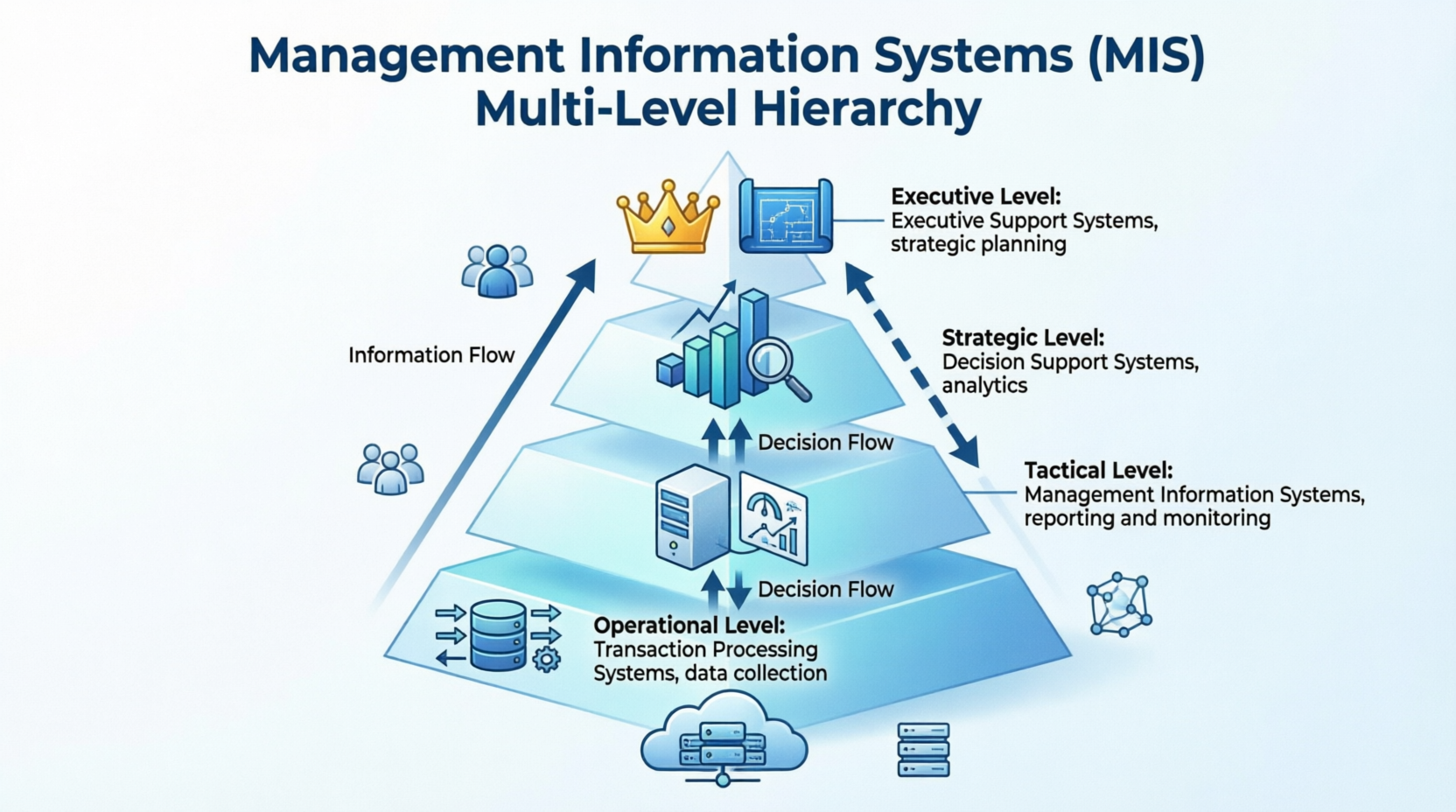
|
Field of Study: Economic, Management, and Commercial Sciences |
1 |
|
Branch: Management Sciences |
2 |
|
Specialization: Common Core |
3 |
|
Semester: (Semester 4) |
4 |
|
Teaching Unit: (Fundamental Unit) |
5 |
|
Course: Management Information Systems (MIS) |
6 |
|
Credits: 06 |
7 |
|
Coefficient: 03 |
8 |
|
Learning style: In-person |
9 |
|
: Number of weekly hours: (3 hours of lectures + 1.30 hours of practical work) |
10 |
|
Lead Professor: Prof. . Bellhacen Bouamama |
11 |
12. Prerequisites (Required Prior Attainment)
This course is designed for second-year students (Semester 4) within the Management Sciences department. Students are expected to have acquired foundational knowledge from the following modules:
· Business Economics (Enterprise Economics).
· Sociology of Organizations.
· Introduction to Business Administration.
· Informatics / Computer Science.
13. General Course Objectives
The course aims to:
· Highlight the growing significance and strategic role of Information Systems (IS) within the enterprise and business management.
· Identify the key challenges and constraints facing Information Systems in a modern organizational context.
· Develop the student’s ability to adopt a Systemic Approach, perceiving the organization as a unified system or a set of integrated subsystems.
· Foster a Process-based Approach to help students understand and analyze information flows within the organization.
14. Learning Outcomes (Targeted Skills)
Upon successful completion of this course, the student will be able to:
· Recognize the strategic value of information as a key organizational asset.
· Understand the various dimensions and subsystems of an Information System (Management, Technical, and Organizational).
· Identify the core components (hardware, software, data, people, and procedures) of IS.
· Define the fundamental functions of Information Systems (Data collection, processing, storage, and dissemination).
· Identify and differentiate between modern business management systems (such as ERP, CRM, and DSS).
15. Required Prior Knowledge
To succeed in this course, students should possess a solid grounding in:
· Economic Concepts: Fundamental principles of micro and macroeconomics.
· Management Sciences: Core theories of management and organizational structure.
· Technological Literacy: Basic understanding of information technology and digital tools.
· Related Academic Backgrounds: Any prior training that facilitates the analytical study of business processes.
16. Course Content:
• Module 1: Information Systems and the Organization
• Module 2: Practical/Operational Modeling
• Module 3: IT Hardware and Equipment Infrastructure
• Module 4: Information Security and Cybersecurity
• Module 5: Spreadsheet-Based Modeling
• Module 6: Data Processing and Management
• Module 7: Physical Implementation of Information Exchanges
• Module 8: Business and Management Software Suites
• Module 9: Enterprise Resource Planning (ERP) Systems
17. Mind Map
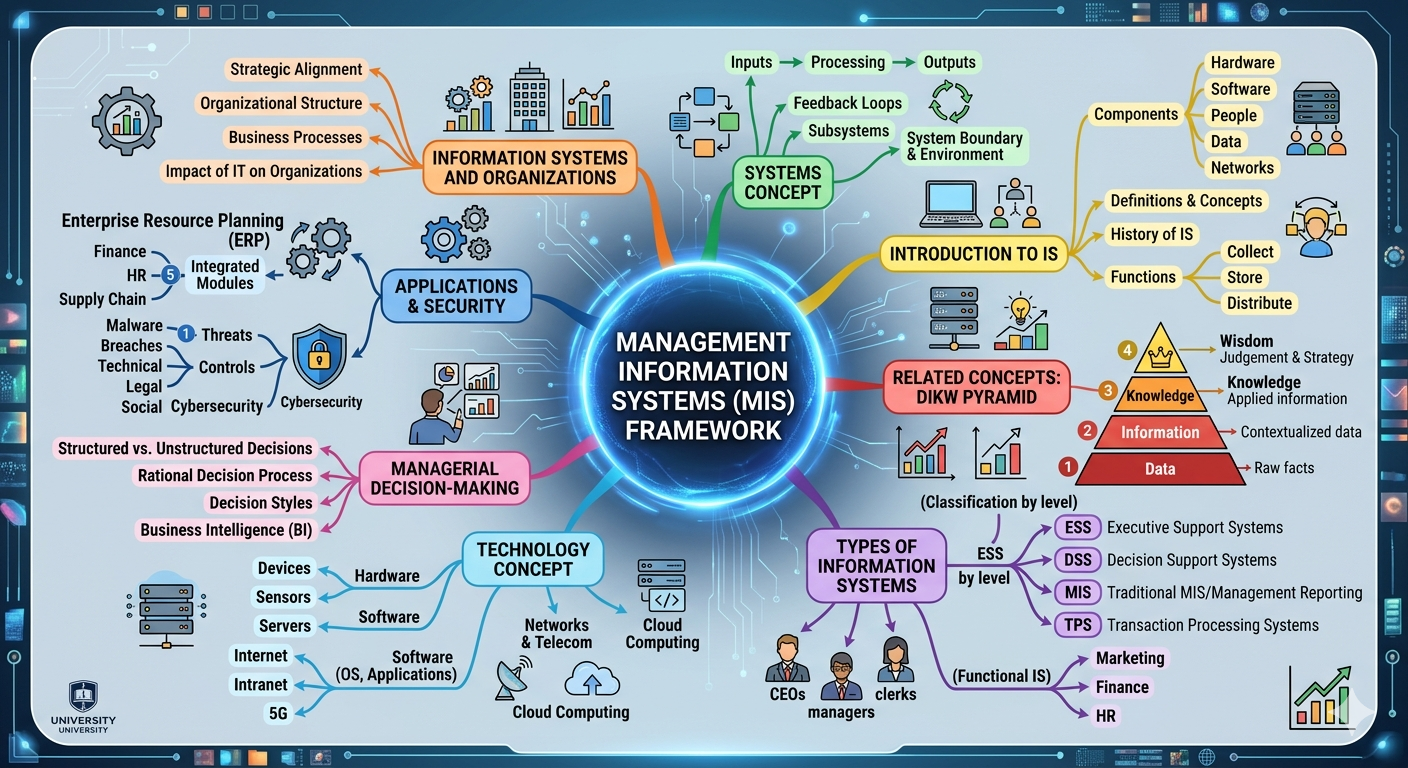
18. Assessment Methods
The final grade is calculated based on a weighted average of continuous evaluation and a final exam:
Continuous Assessment (40%): Includes Practical Work (Labs), Quizzes, and Case Studies.
Final Examination (60%): * A comprehensive written exam covering all theoretical and practical aspects of the syllabus.
19. Reference List
فايز جمعة صالح النجار،نظم المعلومات الإدارية :منظور إداري، دار الحامد للنشر والتوزيع، الطبعة الرابعة، 2013
. René Colletti and Henri Habrias : Analyse et Conception des Systèmes d'Information 1983
. Robert Reix : Management et système d'information, 2016
. Dave Chaffey : Management information system, 2013
. Lucidarme& Polard : Merise - Modélisation des données et des traitements
. Laudonkenneth&Jan laudon : Management information system, 2017
. Les manuels DCG, Management des systèmes d'information, 2015
. Alexis Leon: ERP Demystified, 2014
. " Vinod Kumar Garg and N. K. Venkitakrishnan, Enterprise Resource Planning: Concepts and Practice,2011
- Teacher: Bouamama KHAMRA