

Lesson: Pictures & Caricatures Talks
Theme: Visual Literacy
Duration: 180 minutes
Skills: description, interpretation, evaluation, speaking
1.Activity: “Describe What You See”
After being projected to a random picture (classroom, street, person), students describe it in 2 or 3 sentences to shift their attention from words to images.
2. Caricature for Study (Main Text)
Here is the caricature to use:
Caricature Title: “Different Times, Same Stress” (students imagine the picture first before being projected to the image.)
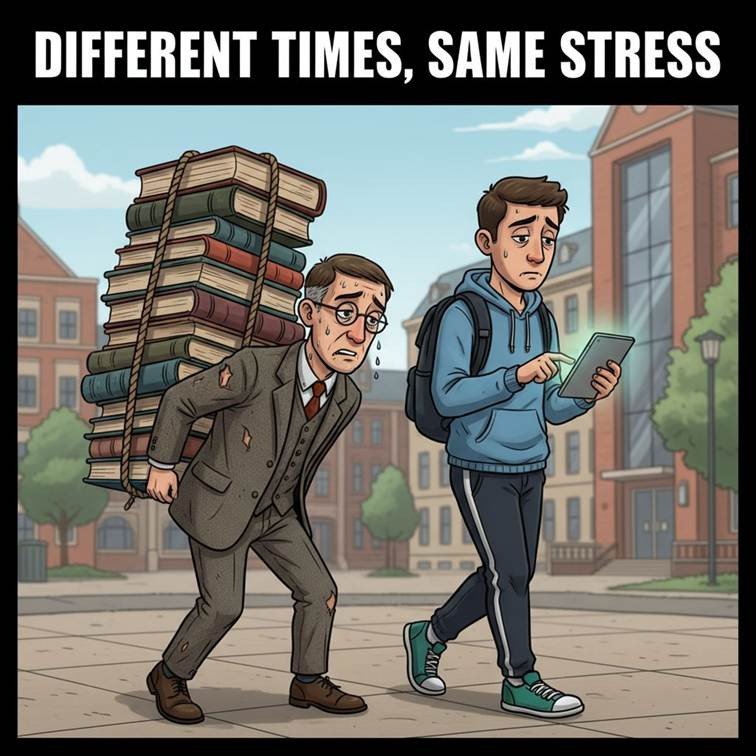
Description of Image:
Two students walk side by side.
• On the left, an old-style student carries ten giant books tied with rope. He leans forward, sweating, almost collapsing.
• On the right, a modern student holds a tiny tablet in one hand, looking relaxed.
• Both students have dark circles under their eyes and tired expressions.
• The caption reads: “Different times, same stress.”
If the picture is not available, the teacher is not obliged to generate images; this description is enough for students to imagine or draw it.
3. First Reading / Viewing (5 minutes)
“What is happening in this caricature?”
Allow free responses.
4. Guided Questions (10 minutes)
What contrast is shown?
What is the message?
What is exaggerated?
What is the tone?
5. Concept Teaching
A Caricature is an exaggerated drawing that uses humour or criticism to comment on a message, issue, or behaviour.
Visual Literacy is understanding how images communicate meaning.
Three Steps of Visual Analysis
- Describe – What do I see?
- Interpret – What does it mean?
- Evaluate – Is the message effective?
6. Practice Activities
Activity 1 — Description Task (10 minutes)
After presenting a picture to the students, they are asked to write five sentences describing only what they see.
No interpretation.
Example criteria: people, objects, colours, movement, expression, setting.
Activity 2 — Pairs: Interpret a Caricature
Each pair is provided by a different caricature (printed or displayed).
They answer:
- What is happening?
- What is exaggerated?
- What is the message?
Pairs share their answers.
Activity 3 — Groups: Evaluate the Image (10 minutes)
Groups of 6 decide if their caricature is effective.
They justify their answer using evidence from the image.
7. Speaking Mini-Presentations (10 minutes)
Students choose one image from the lesson and give a 1-minute talk including:
- Description
- Interpretation
- Evaluation
8. Homework
Prepare a 3-minute talk on a picture or caricature of your choice.
Include: description, interpretation, evaluation.
Bring the image next week.
Tutor: KADECHE Assia
- Teacher: Assia KADECHE
Reading & Writing Workshop – Reports (Meetings, Visits, Books, Films)
Theme: Structured Factual Writing
Tutor: KADECHE Assia
1. Lesson Objectives
By the end of this session, students will be able to:
- Identify characteristics of factual, structured report writing.
- Distinguish between different types of reports (meeting, visit, book review, film review).
- Analyse a model text (book review).
- Apply structure, clarity, and objectivity in their own writing.
- Produce short reports individually and in groups.
2. Warm-Up (5 minutes)
Think–Pair–Share:
What makes a text factual and objective?
Examples of texts to be discussed: news articles, reviews, reports.
3. Text for Study – Model Book Review (Reading Stage)
Book Review Sample: The Old Man and the Sea by Ernest Hemingway
“This short novel tells the story of Santiago, an old Cuban fisherman who has gone many days without catching a fish. One day, he hooks a giant marlin, beginning a long struggle that tests his endurance and courage. Despite pain, loneliness, and exhaustion, Santiago refuses to give up. The novel is simple in language but powerful in meaning, highlighting themes of perseverance, human dignity, and the quiet heroism of ordinary people.”
4. Comprehension Questions
- Who is the main character?
Answer: Santiago, the old fisherman. - What is the main theme?
Answer: Human strength, perseverance, and dignity.
5. Concept Explanation (Teaching Stage)
What is a Report? A report is a piece of writing that:
- Presents facts rather than opinions.
- Follows a clear structure.
- Has an objective tone.
- Is written for a specific audience.
Types of Reports (Table)
|
Type of Report |
Purpose |
Typical Content |
|
Meeting Report |
Summarize what happened in a meeting |
Participants, topics discussed, decisions, actions |
|
Visit Report |
Describe an educational/official visit |
Purpose, observations, outcomes |
|
Book Review |
Evaluate and summarise a book |
Summary, themes, strengths, weaknesses |
|
Film Review |
Evaluate and summarise a film |
Plot, characters, themes, personal reflection |
Diagram: Structure of a Report
+----------------+
| Title |
+----------------+
|
v
+------------------------------+
| Introduction (context) |
+------------------------------+
|
v
+-------------------------------------+
| Body (details, evidence) |
+-------------------------------------+
|
v
+---------------------------------------------------+
| Conclusion (results, opinions, impact) |
+---------------------------------------------------+
6. Language Notes
To maintain objectivity, reports often use:
- Neutral vocabulary (e.g., “observed,” “noted,” “reported”)
- Past tense for describing events
- Present tense for describing content (e.g., in book reviews)
7. Activities (Practice Stage)
Activity 1 – Film Review (Individual)
Write a short 5–6 sentence film review of a movie you have watched.
Use the following structure:
- Title and director
- Short summary
- Main characters
- Theme(s)
- Your evaluation (1–2 sentences only)
Sample Answer (Model):
“In the film Coco, directed by Lee Unkrich, the young boy Miguel dreams of becoming a musician despite his family’s ban on music. During the Day of the Dead, he accidentally enters the Land of the Dead and learns the truth about his ancestors. The film explores family, memory, and identity. With colourful animation and emotional storytelling, Coco is both entertaining and deeply moving.”
Activity 2 – Group Work: Visit Report
Task:
In groups of 4–6, draft a Visit Report about an imaginary trip to a museum, cultural site, or company.
Include:
- Title
- Purpose of the visit
- What you observed
- What you learned
- Conclusion
Sample Notes (Model):
Visit to the National Museum – Purpose: study local history. Observed ancient pottery, traditional clothing, Roman artifacts. Learned about early settlement patterns. The visit enriched our understanding of Algerian heritage.
Activity 3 – Structure Identification (Quick Check)
Read these statements and identify the section they belong to:
|
Statement |
Section |
|
“The meeting was held on Monday at 10 a.m.” |
Introduction |
|
“Students visited the art gallery to study modern sculpture.” |
Introduction |
|
“The guide explained the techniques used by local artists.” |
Body |
|
“The team decided to continue the project next week.” |
Conclusion |
8. Writing a Short Report
Title: Report on the English Club Meeting
Introduction:
The English Club meeting was held on 12 November at 2 p.m. in Room 14. The purpose was to plan the upcoming cultural event.
Body:
Members discussed possible activities such as poetry readings, a short play, and a poster exhibition. Students volunteered for different responsibilities.
Conclusion:
The group decided to schedule the event for the first week of December. A follow-up meeting will be held next Monday.
9. Assessment:
“What are two characteristics of an effective report?”
Expected answers:
- Clear structure.
- Factual and objective.
- Uses formal language.
- Written for a specific purpose.
10. Homework
Choose one of the following and write a full, polished report for your portfolio:
- Book review
- Film review
- Meeting report
- Visit report
Length: 10–12 lines.
Tutor: KADECHE Assia
- Teacher: Assia KADECHE