In this lesson, we will explore electrical transformers of various types, including single-phase and three-phase transformers, and study their operation and key characteristics. Additionally, we will cover power conversion systems in industrial electronics, focusing on converters such as AC to DC, DC to DC, and others. This lesson will provide us with a deeper understanding of the vital role these devices play in controlling and distributing electrical power in electrical systems.
Objective: is to understand the operation of electrical transformers and their types, as well as to study converters and their types in power electronics.
- Teacher: Abdelkader KHENTOUT
Chapitre I :Généralités sur les circuits et réseaux électriques (2 semaines)
I-1- Circuits en CC
I-2- Circuits en AC
I-3- Réseaux « Mono et Triphasé »
- Teacher: Abdelkader KHENTOUT
At the end of this course, the student will be able to establish the general equations for electromechanical energy conversion applied to synchronous, asynchronous, and DC machines, and will know how to determine their characteristics in both steady-state and dynamic regimes. This will notably allow for the consideration of the integration of machines with static converters, as well as learning about the different types of protection and control equipment for electrical installations.
- Teacher: Abdelkader KHENTOUT
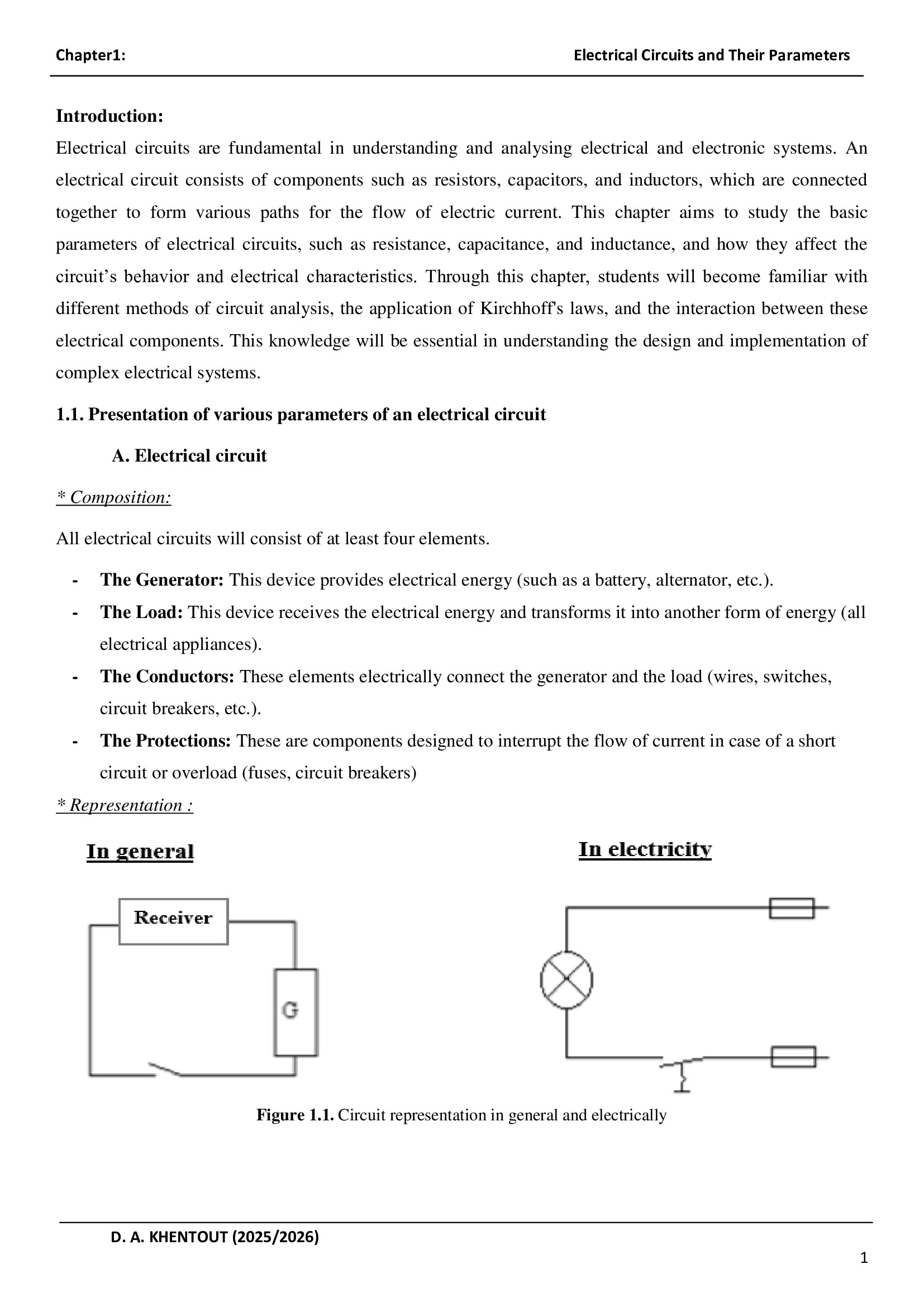
Electrical circuits are fundamental in understanding and analysing electrical and electronic systems. An electrical circuit consists of components such as resistors, capacitors, and inductors, which are connected together to form various paths for the flow of electric current. This chapter aims to study the basic parameters of electrical circuits, such as resistance, capacitance, and inductance, and how they affect the circuit’s behavior and electrical characteristics. Through this chapter, students will become familiar with different methods of circuit analysis, the application of Kirchhoff's laws, and the interaction between these electrical components. This knowledge will be essential in understanding the design and implementation of complex electrical systems.
- Teacher: Abdelkader KHENTOUT