
This module provides a comprehensive introduction to Petroleum Geology with a strong orientation toward Reservoir Engineering applications. It focuses on the geological processes controlling the formation, generation, migration, accumulation, and preservation of hydrocarbons within sedimentary basins.
The course begins with the historical development of petroleum use and the evolution of the petroleum industry. It then examines the physical and chemical properties of crude oil and natural gas, as well as the pressure and temperature conditions governing rocks and fluids in sedimentary basins.
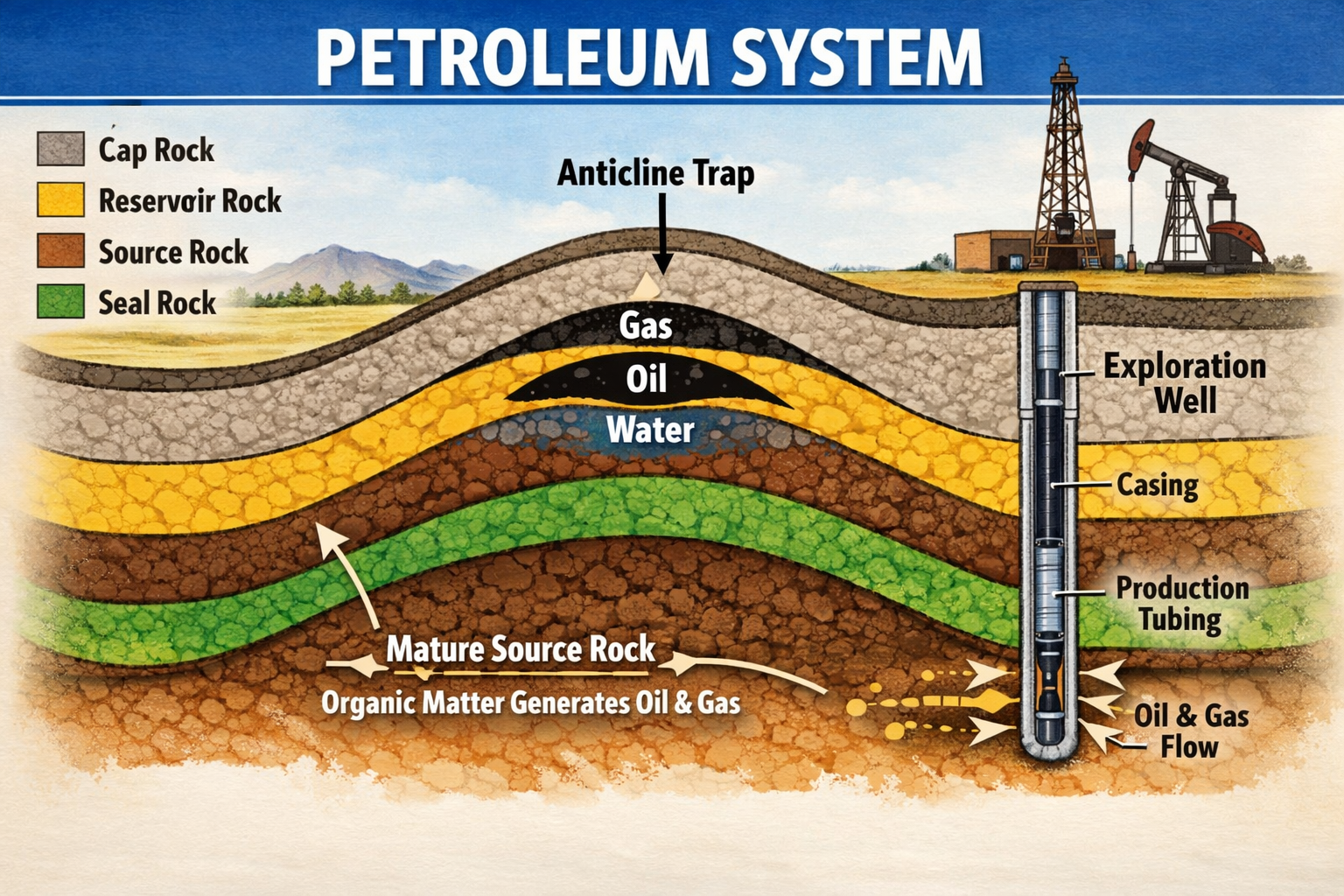
A major part of the module is dedicated to petroleum systems, including source rocks, hydrocarbon generation, migration mechanisms, reservoir rocks, seals, and traps. Students will learn how to analyze petroleum system efficiency and evaluate hydrocarbon potential through geological and geophysical data.
The module also covers exploration techniques such as drilling, well logging, seismic methods (2D, 3D, 4D), and basin modeling. Special attention is given to hydrocarbon resource estimation, reserves classification, and deterministic and probabilistic evaluation methods used in the petroleum industry.
By the end of the course, students will be able to understand petroleum system dynamics, critically interpret subsurface data, and contribute to hydrocarbon prospect evaluation and reservoir characterization.
- Teacher: Nabil BRAHMIA