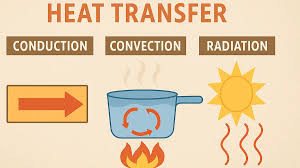
Heat transfer is the physical process of thermal energy moving from a higher-temperature object to a lower-temperature one, driven by temperature differences. It occurs through three primary mechanisms—conduction (direct contact), convection (fluid movement), and radiation (electromagnetic waves)—and is essential for regulating energy in systems, from daily cooking to industrial engineering.
COURSE OBJECTIVES:
1.Students can learn about heat transfer and conduction heat transfer mode.
2.Students can learn types of convection and dimensional analysis.
3.Students can learn the phases of heat transfer
4.Students can learn about heat exchanger performance.
5.Students can learn different laws of radiation and its applications.
UNIT-I
Introduction: Basic modes of heat transfer- Fourier Heat transfer equation– Differential heat conduction equation in Cartesian and Cylindrical coordinate systems. Steady-state one- dimensional heat conduction solutions for plain and composite slabs and cylinders, Critical thickness of insulation.
UNIT-II
Heat conduction through extended surfaces (Fins) -Long Fin, Fin with insulated tip, and Short Fin
- Fin effectiveness and efficiency.
Unsteady state Heat Transfer-Conduction: One Dimensional Transient Conduction Heat Transfer
- Lumped system analysis, and solutions by use of Heisler charts.
UNIT-III
Convection: Dimensional analysis - Buckingham π theorem - Application of dimensional analysis to free and forced convection problems - Dimensionless numbers and Empirical correlations.
Free and Forced convection: Continuity, momentum and energy equations - Boundary layer theory concept - Approximate solution of the boundary layer equations - Laminar and turbulent heat transfer correlation
UNIT- IV
Heat Exchangers: Classification of heat exchangers- Parallel flow- Counter flow- Cross flow heat exchangers- Overall heat transfer coefficient- Fouling factor - Concepts of LMTD and NTU methods Problems using LMTD and NTU methods - Heat exchangers with phase change.
UNIT- V
Boiling and Condensation: Different regimes of boiling- Pool, Nucleate, Transition and Film boiling.
Condensation: Film-wise and drop-wise condensation - Nusselt's theory of condensation on a vertical plate.
Radiation Heat Transfer: Emission characteristics and laws of Black body radiation- Laws of Kirchhoff, Planck, Wien, Stefan Boltzmann – concepts of shape factor – Radiation shields
TEXT BOOKS:
1.Heat Transfer, by J.P.Holman, Int.Student edition, McGraw Hill Book Company.
2.Fundamentals of Heat and Mass Transfer- Sachdeva, New Age Publications
REFERENCE BOOKS:
1.Heat Transfer by S.P.Sukhatme.
2.Heat transfer by Yunus A Cengel.
3.Heat transfer by Arora and Domakundwar, Dhanpat Rai & sons, New Delhi
COURSE OUTCOMES:
1.To identify the modes of heat transfer and calculate the conduction in various solids.
2.To solve the heat transfer rate in convection for various geometric surfaces.
3.To evaluate the heat transfer rate in a phase change process,
4.To design heat exchange equipment based on the need that fits to application.
5.To learn about the radiation and its use in real life.