
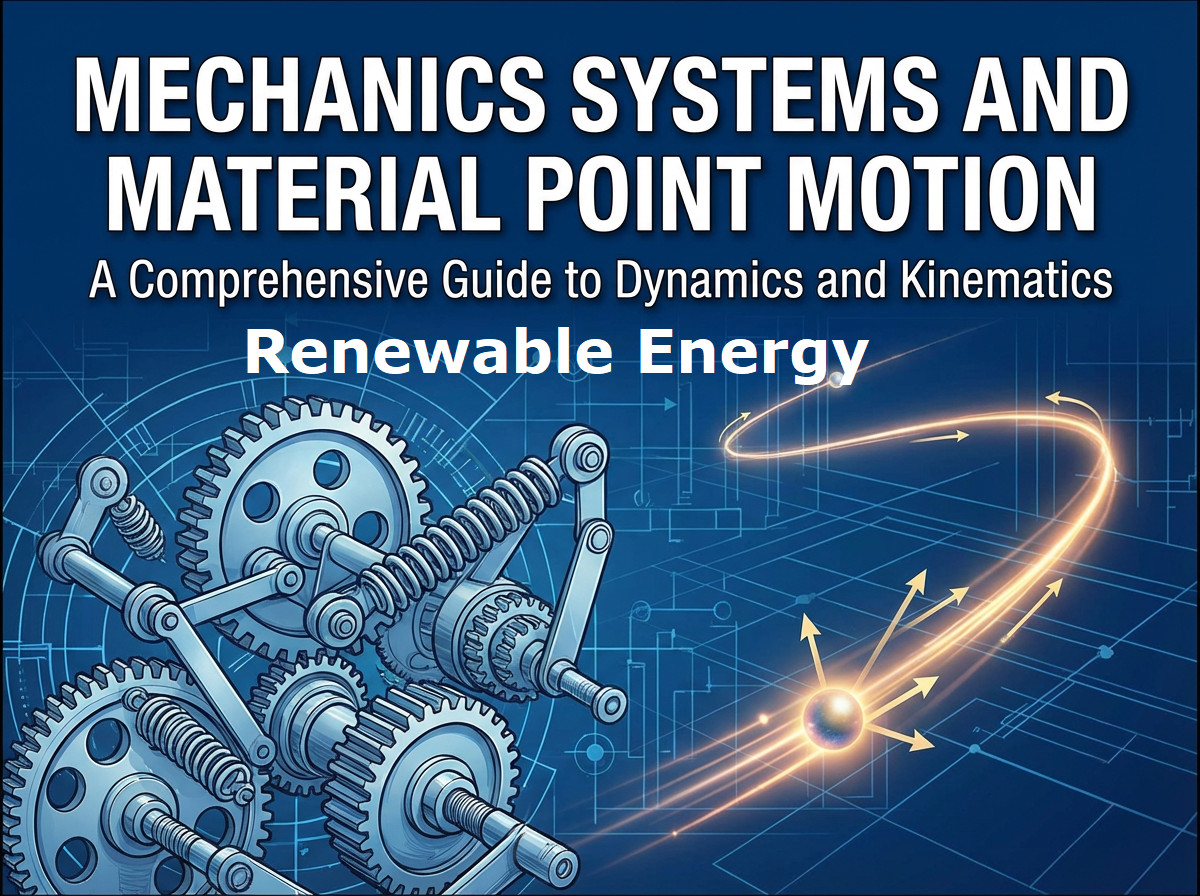
UEF 1.1.2 – Mechanics Fundamentals for Renewable Energy
(6 credits, coefficient 3, 67.5 total hours: 1.5h lecture, 3h tutorials per session)
This foundational mechanics module within the renewable energy engineering program establishes the mechanical principles essential for analyzing and designing energy conversion systems. Despite document encoding issues obscuring specific details, the course structure aligns with standard engineering curricula for renewable energy applications.
Core Content Areas:
· Fluid Mechanics: Flow dynamics governing wind turbine aerodynamics, hydroelectric systems, and heat transfer fluids in solar thermal installations. Covers Bernoulli’s principle, continuity equations, viscous flow, and boundary layer theory.
· Solid Mechanics & Materials: Structural analysis for wind turbine blades, solar panel mountings, and hydroelectric infrastructure. Includes stress-strain relationships, fatigue analysis, composite materials, and failure criteria under cyclic environmental loading.
· Rotational Dynamics: Kinematics and kinetics of rotating machinery central to wind and hydroelectric generators. Topics cover torque, angular momentum, gear train analysis, and vibration characterization.
· Energy Conversion Principles: Mechanical-to-electrical energy transduction, actuator mechanisms for solar tracking systems, and efficiency metrics for mechanical components in renewable energy chains.
· System Modeling: Mathematical modeling of mechanical subsystems using differential equations, numerical simulation of dynamic responses, and integration with power electronics interfaces.
Pedagogical Approach:
The heavy tutorial-to-lecture ratio (2:1) emphasizes problem-solving and practical application. Students analyze case studies from wind, solar, and hydroelectric systems, perform laboratory experiments on scaled models, and complete design projects requiring dimensional analysis and material selection for renewable energy components.
Assessment:
Typical for such modules: continuous evaluation through problem sets, laboratory reports, a midterm examination, and a final design project with oral defense demonstrating mastery of mechanics applied to renewable energy challenges.
- Teacher: Lahcene FELLAH