
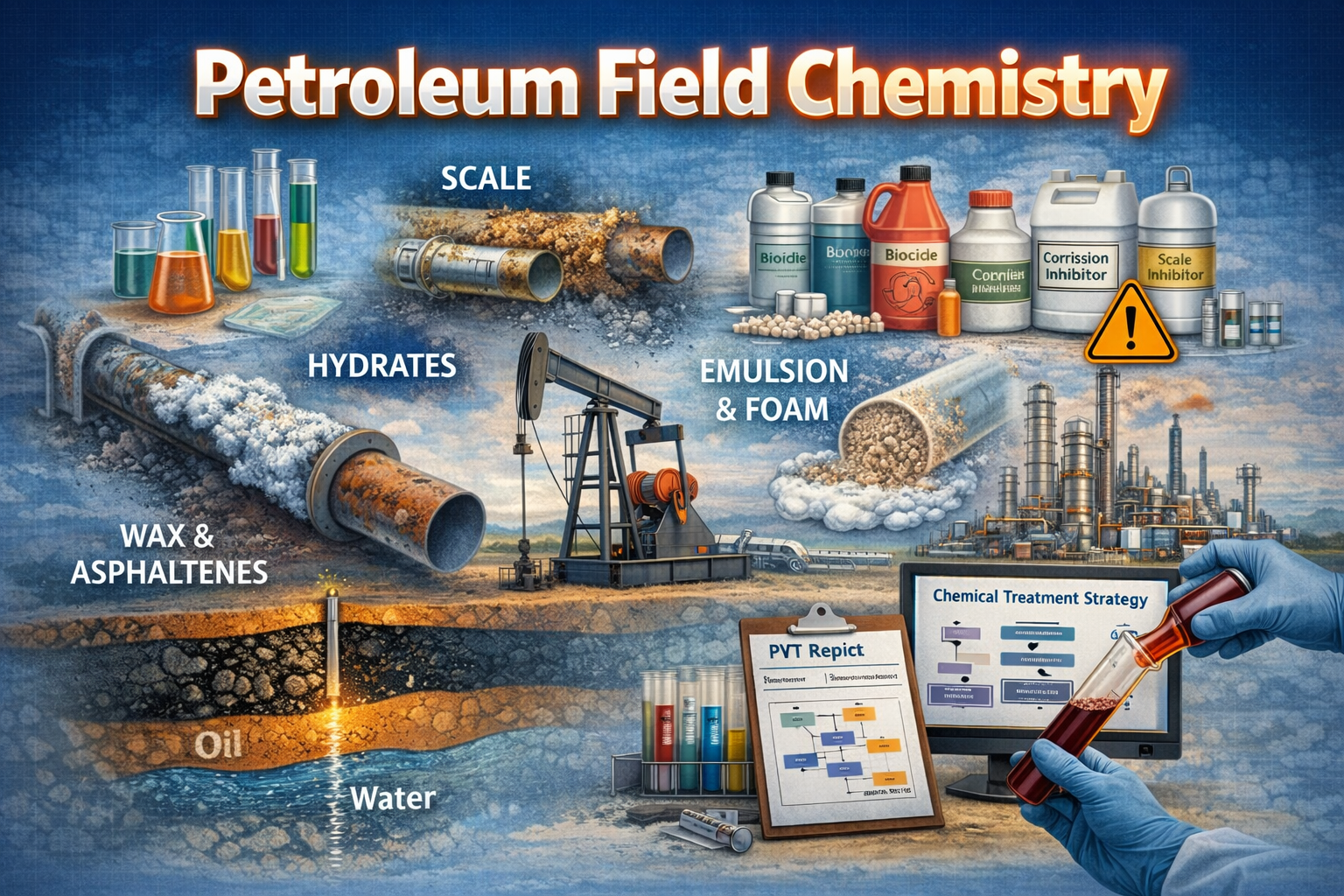
The Petroleum Field Chemistry module focuses on the chemical phenomena encountered during the exploration, production, and processing of hydrocarbons. The course provides a practical and applied understanding of the chemical reactions and interactions occurring between reservoir fluids, rocks, injected chemicals, and production facilities throughout the life cycle of an oil and gas field.
Students will study the chemistry of reservoir fluids (oil, gas, and formation water) and their evolution under changing pressure and temperature conditions. Key topics include scale formation and control, corrosion mechanisms, emulsion and foam formation, wax and asphaltene deposition, hydrate formation, and the use of production chemicals such as inhibitors, demulsifiers, biocides, and corrosion inhibitors.
The module emphasizes field applications, diagnosis of chemical problems, and selection of appropriate chemical treatment strategies. Real field examples and case studies are used to illustrate how chemical issues affect flow assurance, well integrity, production efficiency, and surface facilities.
Learning Outcomes:
By the end of this module, students will be able to:
-
Understand the chemical composition and behavior of petroleum fluids and formation water.
-
Identify common chemical problems in oil and gas fields and their root causes.
-
Analyze scaling, corrosion, emulsion, wax, asphaltene, and hydrate issues.
-
Select and justify appropriate chemical treatments for field operations.
-
Evaluate the impact of chemistry on production performance, safety, and asset integrity.
Prerequisites:
General chemistry and basic petroleum engineering fundamentals.
- المعلم: Zakaria Adjou