
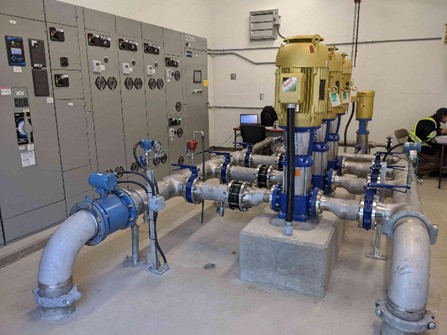
The study of the Pumps and Pumping Stations module enables students to acquire the theoretical knowledge and practical skills necessary for the design, operation, and management of pumping systems. Upon completion of this module, students should be able to:
-
Understand the fundamental laws and principles governing the operation of hydraulic pumps.
-
Analyze the hydraulic behavior and performance characteristics of different types of pumps.
-
Design and size pumping stations for various hydraulic installations.
-
Select appropriate pumps according to the required flow rate, total dynamic head, and operating conditions.
-
Determine the installation level (pump setting) and operating point of pumping systems.
-
Design and analyze pump arrangements and couplings, including series and parallel operation.
-
Select the mechanical, hydraulic, electrical, and control equipment associated with pumping stations.
-
Design and size surge protection systems and water hammer protection devices.
-
Evaluate pump efficiency, cavitation conditions, and energy consumption.
-
Operate, supervise, and manage pumping stations safely and efficiently.
-
Apply engineering standards and economic criteria in the design and operation of pumping systems.
The study of this module provides students with essential competencies required in the fields of hydraulic engineering, water supply systems, irrigation, wastewater treatment, industrial installations, and energy production systems.
|
Chapter |
Topic |
|
References and Bibliography |
|
|
1 |
Introduction to Pumps and Pumping Stations |
|
2 |
History and Evolution of Pumps |
|
3 |
Turbomachines |
|
4 |
Classification of Pumps |
|
5 |
Centrifugal Pumps |
|
6 |
Components of Centrifugal Pumps |
|
7 |
Flow Inside the Impeller and Velocity Triangles |
|
8 |
Fundamental Equation of Turbomachines |
|
9 |
Pump Similarity Laws |
|
10 |
Characteristics of Centrifugal Pumps |
|
11 |
Pump Efficiency |
|
12 |
Cavitation and NPSH |
|
13 |
Pumping Stations |
- Enseignant: KAMEL NETTARI