
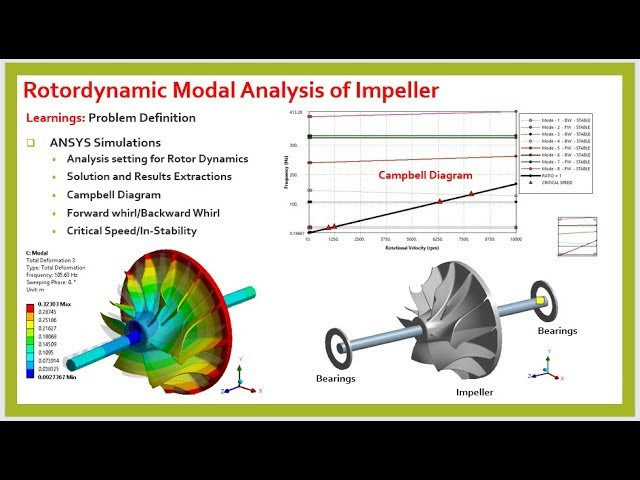
This course provides a comprehensive introduction to the vibrations of rotating machines. It aims to equip students with a solid understanding of the physical principles underlying vibratory dynamics in rotors and rotating machinery. Students will learn advanced modeling techniques specifically adapted to rotating systems, including analytical and finite element approaches. The course emphasizes the mastery of numerical solution methods and the selection of appropriate models for real industrial applications.
The course begins with an introduction to rotor dynamics, covering essential components like shafts, discs, bearings, and unbalance. It then explores fundamental principles including Hamilton’s principle and energy formulation (kinetic and strain energy of discs and rotors, as well as external forces and bearing effects). Students will develop skills in deriving equations of motion for rotors using both analytical and finite element models. Key topics include critical speeds, Campbell diagrams, rotor instability phenomena, and balancing techniques for rotating machinery.
Recommended prior knowledge includes single-degree-of-freedom oscillators, rigid body dynamics, second-order linear differential equations, and basic linear algebra. The course combines theoretical foundations with practical industrial case studies, preparing students to analyze and solve vibration-related problems in real rotating systems.
- Enseignant: RASSIM BELAKROUM